
Quick answer: every camping trip needs the same core: the Ten Essentials (navigation, light, sun protection, first aid, a knife or tool kit, fire, emergency shelter, extra food, extra water and extra clothes), a shelter and sleep system rated for the coldest night you expect, a simple camp kitchen with a way to treat water, and clothing you can layer. Build from that core for your trip type, pack the car in reverse order of use, and dry and clean everything before it goes back into storage.
In this guide
- Start With the Ten Essentials
- Gear by Trip Type
- Shelter and Sleep Systems
- The Camp Kitchen and Water
- Clothing and Layers by Season
- Tools, Lighting and Safety Gear
- Power and Electronics
- Camping With Kids and Pets
- Packing and Organization
- Printable Checklists
- Gear Care and Storage
- Frequently Asked Questions
- Related Guides
Packing for camping is a balance between being ready and carrying too much. Forget the tent poles and the trip is in trouble; bring three coolers and a second lantern you never use and the car is packed to the roof for nothing. A checklist solves both problems, but only if it fits the kind of trip you are taking.
Gear lists online range from twenty items to two hundred. Most of the difference comes from trip type. A two-night car camping weekend at a developed campground, a backpacking loop, an RV trip and a winter overnight all share the same core needs, then add very different extras on top.
Each section below covers one part of the kit, explains what matters when choosing it, and links to deeper guides and printable checklists. Safety guidance draws on the National Park Service (NPS), the U.S. Consumer Product Safety Commission (CPSC), the Centers for Disease Control and Prevention (CDC) and the Leave No Trace Center for Outdoor Ethics. Rules and conditions vary, so check the regulations and forecast for your exact destination before you go.
Start With the Ten Essentials
The Ten Essentials began as a safety list from The Mountaineers, a Seattle outdoor club, in the 1930s, and the club’s textbook Mountaineering: The Freedom of the Hills made the list widely known. The NPS now publishes its own version for park visitors. It applies to day hikes from camp as much as to backcountry trips, and it is the best starting point for any camping checklist.
The NPS version of the Ten Essentials is:
- Navigation: a map, compass and the knowledge to use them, plus a GPS device or phone app as backup.
- Headlamp: with extra batteries.
- Sun protection: sunglasses, sun-protective clothing and sunscreen.
- First aid: including foot care and insect repellent if needed.
- Knife: plus a gear repair kit.
- Fire: matches, a lighter and tinder, or a stove.
- Shelter: carried at all times, even if only a lightweight emergency bivy.
- Extra food: beyond the minimum expectation.
- Extra water: beyond the minimum, or the means to purify it.
- Extra clothes: beyond the minimum expectation.
Car campers often skip this list because the car feels like a backup. The car does not come along on the afternoon hike, though, and a lot of camping emergencies happen a mile from the campsite. Keep a small daypack packed with the Ten Essentials and grab it every time you leave camp.

Gear by Trip Type
The core stays the same, but the extras change with how you travel and where you sleep.
Car Camping
Weight barely matters, so comfort items earn their place: a larger tent, thick sleeping pads, camp chairs, a two-burner stove, a full-size cooler, a table and a lantern. The risk is overpacking, so plan meals and sleeping arrangements first and pack to that plan. Our car camping checklist lists the full set for a typical developed campground.
Backpacking
Every item is carried, so the list shrinks to essentials and multi-use gear. A light tent or shelter, a compressible sleeping bag, an insulated pad, a small stove, a water filter or treatment, and one set of layers cover most trips. Food becomes dry and calorie-dense, and storage often requires a bear-resistant canister where agencies require one.
RV and Van Camping
The vehicle provides shelter, a bed and usually a kitchen, so the checklist shifts toward hookup gear, leveling blocks, hoses, tank supplies and tools. Our RV camping checklist for families covers those items in detail.
Beach and Humid Southern Camping
Coastal and humid campsites, including much of Florida, add their own needs. Sand stakes or extra-long stakes hold tents in loose ground, mesh-heavy tents with good ventilation reduce condensation, and a canopy or tarp creates shade at sites with few trees. Insect repellent and a screened shelter matter more here than almost anywhere, and coolers need extra ice because heat shortens how long it lasts. Check tide charts for beach sites and avoid pitching below the high-tide line.
Hot, Wet and Cold Conditions
Weather changes the list more than anything else. Hot-weather trips need shade, more water and sun protection. Wet trips need a tent with a full-coverage rainfly, a ground tarp tucked under the floor, and rain gear for everyone. Cold trips need a warmer sleeping bag, a pad with a higher insulation rating, more layers and a plan for keeping water from freezing.

Shelter and Sleep Systems
Sleep is where most first-time campers have a bad night, and it is usually because of the ground rather than the air. A good system has three parts: the tent, the sleeping bag and the pad.
Tents
Tent capacity ratings describe how many standard sleeping pads fit side by side, with little room left over for gear. Many families size up by one or two people for comfort. Season ratings matter too: three-season tents handle spring, summer and fall conditions, while four-season tents are built for snow loads and strong wind. Look for a rainfly that reaches close to the ground, sealed or taped seams, and enough vestibule space to keep wet boots and packs out of the sleeping area.
Footprints, Tarps and Site Setup
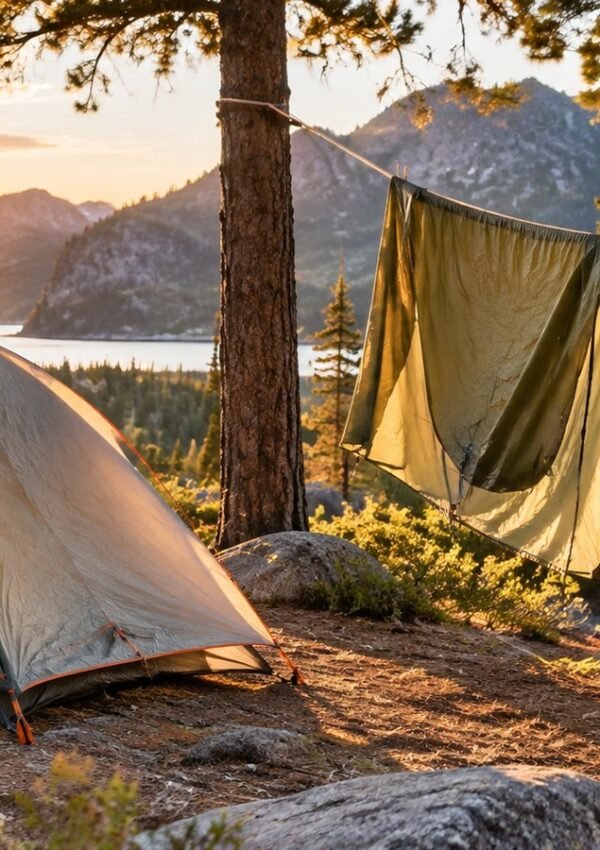
A footprint or ground tarp protects the tent floor from abrasion and adds a layer between you and wet ground. Keep it slightly smaller than the tent floor; any edge that sticks out will catch rain and channel it underneath. A second tarp strung over the picnic table or cooking area creates a dry space to cook and sit during showers. Bring enough cord and stakes to pitch it tight, since a sagging tarp collects water.
Site choice affects comfort as much as gear. Pitch on a durable, level surface, ideally an established tent pad, away from dead trees and branches overhead, and out of low spots where water pools. Leave No Trace guidance favors established sites and durable surfaces to protect vegetation.
Sleeping Bags
Many sleeping bags are tested to the international standard ISO 23537, which reports a comfort rating, a lower limit rating and an extreme rating. The comfort rating is the most realistic number for most sleepers, and the extreme rating is a survival figure, not a target. Choose a bag whose comfort rating is at or below the coldest night in the forecast.
Sleeping Pads
Pads insulate you from the ground, which pulls heat away much faster than air. Since 2020, many manufacturers rate pads using the ASTM F3340 standard, which produces a comparable R-value. Higher numbers insulate better, and under that standard the R-values of two stacked pads can be added together. A thin summer pad on cold ground can make a warm bag feel useless, so match the pad to the season as carefully as the bag.

The Camp Kitchen and Water
The camp kitchen is the second-biggest part of most checklists. A practical set includes a stove and fuel, a lighter and backup matches, a pot and pan, utensils, plates, cups, a cutting board, a cooler, biodegradable soap, a wash basin, trash bags and a way to treat water. Our camping food guide covers meal planning, cooler packing and cooking methods in depth.
Kitchen Checklist
- Stove, fuel and a lighter with backup matches.
- Pot, pan, kettle or coffee maker, and a lid.
- Spatula, tongs, serving spoon, can opener and a sharp knife in a sheath.
- Plates, bowls, cups and utensils for each person.
- Cutting board, aluminum foil, zip-top bags and food storage containers.
- Cooler with block ice, plus a thermometer if you want to check temperatures.
- Water jug, wash basin, biodegradable soap, sponge and a quick-dry towel.
- Trash and recycling bags, since many campgrounds expect you to pack out what you bring.
Stove Safety
The CPSC warns never to use a camp stove, grill, heater, generator or any other fuel-burning device inside a tent, camper or other enclosed space, because carbon monoxide can build up quickly and kill. Cook outside, in the open, and store fuel away from the sleeping area.
Water
Developed campgrounds usually have potable water, but backcountry sites and many primitive campgrounds do not. The CDC advises that boiling is the surest way to kill disease-causing germs: bring clear water to a rolling boil for one minute, or three minutes above 6,500 feet. Filters and chemical treatments are lighter options, and each has limits listed on its packaging.
Fire
Check current fire restrictions before every trip, since bans can apply even to campfires in established rings. Buy or gather firewood near your destination rather than bringing it from home. The Don’t Move Firewood campaign, run by The Nature Conservancy, explains that firewood can carry invasive insects and diseases to new forests.

Clothing and Layers by Season
Clothing is part of your shelter. The layering system used by most outdoor guides has three parts: a base layer that moves sweat away from skin, an insulating mid layer such as fleece or a puffy jacket, and a shell that blocks wind and rain. Adding or removing layers is easier than relying on one heavy coat.
Cotton is comfortable in dry heat but a poor choice in cool or wet weather, because it holds moisture and loses its insulating value when damp. Wool and synthetic fabrics stay warmer when wet. Pack a dry set of clothes reserved for sleeping, and keep it in a waterproof bag so it stays dry no matter what the day brings.
A Simple Clothing List
- Base layers: moisture-wicking shirts and, for cool nights, long underwear.
- Insulation: a fleece or insulated jacket, plus a warm hat.
- Rain shell: a waterproof jacket and, in wet climates, rain pants.
- Legs: hiking pants or shorts depending on season.
- Socks: several pairs, including thick ones for sleeping.
- Footwear: broken-in hiking shoes or boots and camp shoes.
- Sun protection: a brimmed hat and sunglasses.
- Sleepwear: a dedicated dry set.
Cold-weather trips call for a warmer version of every layer: a heavier base layer, a thicker insulated jacket, gloves, a warm hat for sleeping and an extra pair of dry socks for the night.
Tools, Lighting and Safety Gear
Small tools solve most problems at camp. A multi-tool or knife, duct tape, extra cord, a mallet for tent stakes, a small repair kit for tents and pads, and a few spare stakes cover most surprises.
Lighting
Pack one headlamp per person plus a lantern for the camp table. Headlamps keep hands free for cooking and nighttime trips to the restroom, and a red-light mode helps preserve night vision. Bring spare batteries or a way to recharge.
First Aid
A first aid kit should match group size and trip length. The American Red Cross publishes a recommended list for a family first aid kit that is a useful starting point, and campers usually add blister care, tweezers for splinters and ticks, and any personal medications. Check expiration dates before every season.
Bugs and Sun
The CDC recommends EPA-registered insect repellents, which include products with DEET, picaridin, IR3535, oil of lemon eucalyptus, PMD or 2-undecanone, and suggests treating clothing and gear with permethrin in tick areas. The American Academy of Dermatology recommends a broad-spectrum, water-resistant sunscreen with SPF 30 or higher.
Navigation and Communication
Cell coverage is unreliable in many parks and forests. Carry a paper map of the area, know how to read it, and leave a trip plan with someone at home that lists where you are going and when you expect to return. A whistle and a small signal mirror weigh almost nothing. For remote trips, many campers add a satellite messenger or personal locator beacon, which can send an emergency signal without cell service.

Power and Electronics
Phones now handle maps, weather alerts, photos and emergency calls, so power has become a real part of the checklist. Options range from small power banks to larger portable power stations that can run lights, fans or CPAP machines at sites without hookups.
Battery capacity is usually listed in milliamp-hours for power banks and watt-hours for power stations. Check what your devices actually need before buying bigger. Download offline maps before you lose signal, and carry a paper map anyway, since the Ten Essentials list treats electronics as a backup for navigation rather than a replacement.
Flying to a trip adds one rule worth knowing: the Federal Aviation Administration requires spare lithium batteries and power banks to travel in carry-on bags, not checked luggage. Store batteries away from heat in the car, and keep electronics in a dry bag in wet weather.

Camping With Kids and Pets
Children need the same core gear as adults, sized to fit, plus a few extras: familiar bedding or a small pillow, extra clothes for the inevitable mud, a headlamp of their own, and simple games for downtime. A whistle is a useful safety item, and many outdoor educators teach children to stay put and blow it if they are lost. Our family camping checklist is a quick printable for the whole group.
Pets need food, water, bowls, a leash, waste bags, bedding, any medications and proof of vaccinations, since some campgrounds ask for it. NPS rules in most national parks require pets to be on a leash no longer than six feet, and many trails and wilderness areas do not allow pets at all, so check the park’s pet page before you pack.

Packing and Organization
Good organization saves more time at camp than any gadget. Group gear into labeled bins or bags by function: kitchen, shelter, lighting and tools, clothing, and personal items. A camp kitchen bin that stays packed between trips means you only need to restock food and fuel.
Load the car in reverse order of use. Items you need last, such as the camp kitchen and extra clothes, go in first, while the tent, ground tarp and a rain jacket go in last so they come out first. Keep the Ten Essentials daypack, snacks, water and a first aid kit within reach of the driver. Heavy items belong low and forward to keep the load stable, and nothing should block the driver’s view.
Before leaving home, set up the tent once if it is new or has been in storage, and check that every pole, stake and fly is there. A ten-minute check in the backyard prevents the most common gear disaster in camping.

Printable Checklists
Printable checklists turn a long list into a routine. Keep one copy in the gear bin, check items off as you pack, and add notes after each trip about what you missed or never used.
Our printable lists cover the most common trip types:
- The family camping checklist for group trips with children.
- A car camping checklist PDF for developed campgrounds.
- An RV checklist for families that covers hookups, tanks and leveling.
For extra ideas beyond the basics, our list of camping gadgets covers useful small tools and comfort items worth considering once the essentials are covered.

Gear Care and Storage
Gear lasts longer when it is cleaned and dried after every trip. Mildew is the main enemy of tents and sleeping bags, and it starts when gear is packed wet and left in a garage or trunk. Set up or hang the tent to dry fully as soon as you are home, shake out the dirt, and store it loosely in a cool, dry place.
Sleeping bags keep their loft best when stored uncompressed in a large cotton or mesh sack rather than the small stuff sack used on the trail. Clean stove burners, empty and dry water containers, and remove batteries from headlamps and lanterns to prevent corrosion. Replace anything used up from the first aid kit right away. Our guide to camping gear care explains washing and drying methods for tents, bags and pads step by step.
Frequently Asked Questions
What are the most important things to bring camping?
Start with the Ten Essentials, a shelter and sleep system rated for the expected low temperature, a way to cook, safe drinking water or a way to treat it, and layered clothing.
How warm should my sleeping bag be?
Choose a bag whose comfort rating, under the ISO 23537 standard where listed, is at or below the coldest night you expect, and pair it with a pad that has an adequate R-value for the season.
Do I need the Ten Essentials for car camping?
Yes, for any hike or outing away from the car. Keep them in a daypack so they go wherever you go.
Can I use a heater or stove inside my tent?
No. The CPSC warns that fuel-burning devices in tents and campers can cause deadly carbon monoxide poisoning.
How do I stop forgetting things?
Use a printed checklist, keep a permanently packed kitchen bin, and add notes after each trip about what was missing.
How should I store camping gear between trips?
Dry everything fully, store tents and sleeping bags loosely in a cool, dry place, and remove batteries from electronics.Sources: National Park Service, Ten Essentials and pet rules; The Mountaineers, Mountaineering: The Freedom of the Hills; U.S. Consumer Product Safety Commission, carbon monoxide guidance for campers; Centers for Disease Control and Prevention, drinking water treatment and insect repellent guidance; American Academy of Dermatology, sunscreen recommendations; American Red Cross, first aid kit contents; Federal Aviation Administration, lithium battery rules; ISO 23537 sleeping bag standard; ASTM F3340 sleeping pad R-value standard; The Nature Conservancy, Don’t Move Firewood; Leave No Trace Center for Outdoor Ethics.

Leave a Reply