Quick answer: driving an RV safely starts with knowing your rig’s exact height, length and weight, and planning routes that avoid low bridges, weight-restricted roads and tunnels that ban propane. Make wide turns to clear curbs and watch for tail swing, leave much more following distance than in a car, brake early and use lower gears on long downhill grades. Adjust mirrors before every drive, use a spotter when backing, slow down in crosswinds and plan fuel stops at stations with room to maneuver. Practice in an empty lot before your first trip, and check whether your state requires a special license for heavier or longer RVs.
The first time you pull an RV onto a highway, the size of it becomes very real. A motorhome or travel trailer is taller, longer, heavier and slower to stop than any car, and it responds differently to wind, hills and tight corners. The good news is that most RV driving skills are simple habits that become automatic with practice.
This guide covers the basics every new RV driver should know before setting out. For a broader overview of rigs, costs and campgrounds, see our beginner’s guide to RV and van camping.
Sources: National Highway Traffic Safety Administration (NHTSA) safety guidance on vehicle loading, tires and towing; Federal Highway Administration (FHWA) information on bridge clearances and truck routes; state Department of Motor Vehicles license requirements for recreational vehicles; RV Industry Association (RVIA) consumer safety information; manufacturer owner’s manuals and weight labels; tunnel authority rules on vehicles carrying propane. License and road rules vary by state and change over time, so confirm with official sources. Checked November 2026.

Know Your Rig's Numbers
Height
Measure your RV from the ground to the highest point, including the air conditioner, roof vents, satellite dish, antennas and anything on a roof rack. Many Class A motorhomes and fifth wheels stand around 12 to 13.5 feet tall, while camper vans are much lower; our guide to types of RVs compares sizes. Write the height on a label and stick it on the dashboard where you can see it. Bridges, gas station canopies, drive-throughs, tunnels and parking garages all have clearance limits, and older bridges in particular can be lower than drivers expect.
Length
Know your total length, including bikes, cargo carriers and a towed car or trailer. Some state parks, national forest campgrounds and scenic roads restrict vehicle length. Going-to-the-Sun Road in Glacier National Park, for example, has well-known vehicle length and width limits along its narrowest section.
Weight
Your RV’s weight affects braking, handling and which bridges and roads you can legally use. Check the weight label inside a cabinet door or on the frame for ratings such as gross vehicle weight rating (GVWR) and gross combination weight rating (GCWR). Weigh the loaded rig at a public scale before a big trip. Our guide to RV weight ratings explains what each number means and how to stay within them.
| Number | Where to find it | Why it matters |
|---|---|---|
| Height | Measure yourself, including roof gear | Bridges, canopies, tunnels, trees |
| Length | Owner’s manual plus anything added | Campgrounds, scenic roads, turns |
| GVWR | Weight label on the RV | Legal and safe maximum loaded weight |
| GCWR | Weight label or tow vehicle manual | Maximum combined weight when towing |
| Tire pressure | Tire and loading placard | Handling, braking and blowout risk |

Turning and Tail Swing
Make wide turns
RVs need more room to turn than cars because the rear wheels track inside the path of the front wheels. On right turns in particular, drivers must pull farther into the intersection before turning so the rear wheels do not ride over curbs or clip signs and poles. Many instructors suggest waiting until the front of the RV is roughly even with the curb you are turning around before starting the turn.
Watch the tail swing
A motorhome with a long overhang behind the rear axle swings its back end outward in the opposite direction of a turn. Pulling out of a tight gas station or campsite, that tail can hit pumps, posts or other vehicles. Check your mirrors as you turn and leave space on both sides.
Plan for tight spots
Before turning into an unfamiliar parking lot or campground loop, look ahead for a clear exit. It is far easier to drive past and come back than to discover you cannot turn around.

Braking, Following Distance and Hills
Leave more room
A loaded RV takes much longer to stop than a passenger car. Increase your following distance well beyond the usual car rule of thumb, especially in rain, at night and on downhill grades. Brake early and gently, and look farther down the road so you see slowdowns before you reach them.
Use lower gears on descents
On long downhill grades, riding the brakes can overheat them and reduce stopping power, a problem known as brake fade. Shift into a lower gear or use your engine’s tow/haul mode or exhaust brake if your RV has one, so the engine helps control speed. Watch for warning signs about steep grades and truck runaway ramps, which signal especially long or steep descents.
Climbing
On steep climbs, expect to slow down. Use the right lane and turnouts to let traffic pass, and keep an eye on engine and transmission temperature gauges. Many states require slow vehicles to pull over when five or more vehicles are lined up behind them on two-lane roads; check the rules in the states you visit.

Mirrors, Blind Spots and Backing
Set mirrors before you go
Adjust flat and convex mirrors so you can see the lanes beside you and the ground near the rear wheels. Many drivers also use a backup camera and side cameras. Even with cameras, RVs have large blind spots on both sides and directly behind.
Backing with a spotter
Backing into a campsite is a common source of dents and damage. Use a spotter whenever possible and agree on hand signals or use two-way radios or phones. The spotter should stand where the driver can see them in a mirror and should never stand directly behind the RV. If you lose sight of your spotter, stop. Get out and look whenever you are unsure; it takes seconds and can save an expensive repair.
Practice first
Spend an hour in an empty parking lot before your first trip. Practice right and left turns around cones or markers, backing in a straight line, backing into a space and stopping smoothly. Renters can ask the rental company for a walkthrough, and some RV dealers and clubs offer driving courses.

Wind, Weather and Road Conditions
Tall, flat-sided RVs catch crosswinds, and gusts can push the rig toward another lane. Slow down in windy conditions, keep both hands on the wheel and be ready for sudden pushes when passing trucks, crossing bridges or coming out from behind hills. NWS high wind warnings often note difficult travel for high-profile vehicles; many experienced RVers simply wait out windy days.
Rain reduces traction and visibility, and RVs take longer to stop on wet roads. In snow and ice, most RV owners avoid driving altogether. Check the forecast and road conditions through state 511 services before setting out.

Tires, Loading and Pre-Trip Checks
Tires carry a lot of responsibility on an RV. NHTSA recommends checking tire pressure regularly when tires are cold and inflating them to the pressure on the vehicle’s placard, not the maximum printed on the tire sidewall. Look for cracks, bulges and uneven wear, and check the date code, since RV tires often age out before they wear out. Our guide to RV tire safety covers inspection in more detail.
Before every drive, walk around the rig and check:
- Slide-outs, awnings, steps and antennas retracted
- Doors, compartments and windows closed and latched
- Hookups disconnected and stowed
- Loose items inside secured or stored
- Lights and turn signals working
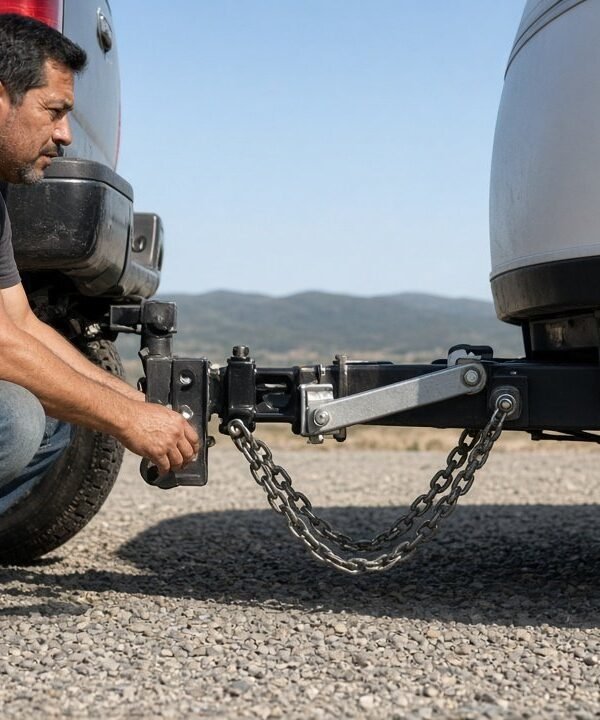
- Hitch, safety chains and breakaway cable connected if towing

Route Planning and Fuel Stops
Avoid low clearances and restricted roads
Car navigation apps do not know your RV’s height or weight. Use an RV-specific GPS or app that lets you enter your rig’s dimensions, and still watch for posted clearance and weight signs. Parkways and scenic roads in some areas restrict commercial vehicles and may have low stone bridges that are hard for large RVs.
Propane and tunnels
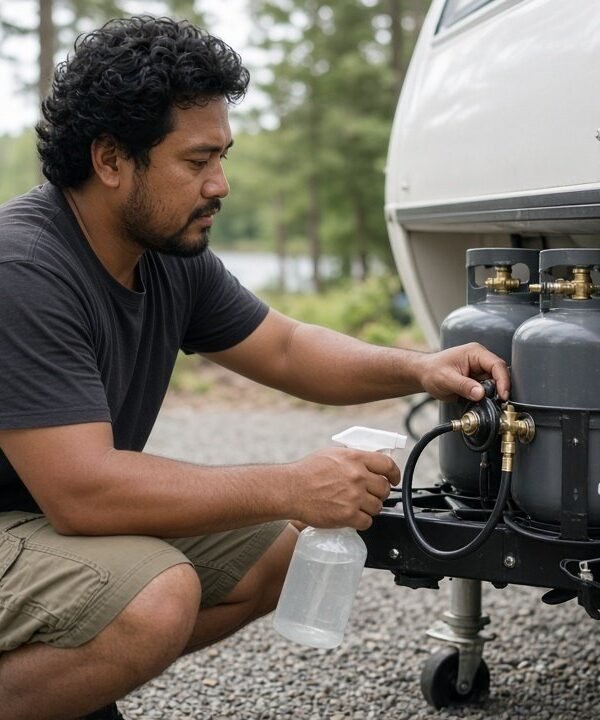
Some tunnels restrict or ban vehicles carrying propane cylinders, including several on major East Coast routes. Others require cylinders to be turned off. Check the tunnel authority’s rules before your trip, and keep propane valves closed while driving through any tunnel or while refueling, as many manufacturers recommend.
Fuel stops
Plan fuel stops at stations with high canopies and wide lanes, such as truck stops with RV lanes or stations with pumps on the outside edge. Pull in so you have a straight exit. Many RVers refuel when the tank reaches half full, rather than waiting until it is nearly empty, to avoid being forced into a tight station.
Daily distance
Many RVers follow a loose “2-2-2” rule of thumb: drive no more than about 200 miles a day, arrive by 2 p.m. and stay at least two nights. It is not a rule from any agency, but it reflects how much more tiring RV driving is than car travel. Shorter days also mean arriving at campgrounds in daylight, which makes setup much easier.

Fatigue, Night Driving and Breaks
RV driving takes more concentration than car driving. You are constantly checking mirrors, judging lane position and watching for clearances. That extra mental work makes drivers tired faster. NHTSA identifies drowsy driving as a serious safety problem and lists warning signs such as frequent yawning, trouble keeping your eyes open, drifting from your lane and missing exits or signs.
A few habits help:
- Plan a break roughly every two hours, or sooner if you feel tired.
- Share driving with another licensed adult who has practiced with the rig.
- Avoid driving late at night, when fatigue peaks and it is harder to spot low branches, potholes and campground signs.
- Eat light meals and stay hydrated; heavy meals can make drowsiness worse.
- If you feel sleepy, pull over at a safe place and rest. Caffeine helps only briefly.

Parking and Overnight Stops
Rest areas and big-box stores
Rules for overnight parking vary widely. Some states allow short rest stops at highway rest areas but prohibit overnight camping, while others post specific time limits. Some big-box stores and truck stops allow RVs to park overnight, but the decision is usually made store by store and can be limited by local ordinances. Always ask permission, park away from storefronts, and do not put out slides, awnings, chairs or grills.
Parking lots and street parking
Many cities restrict parking oversized vehicles on streets, and RVs often do not fit standard parking spaces. Look for lots with long pull-through spaces, park at the edge where you can drive straight out, and remember that your rig may overhang curbs or block sightlines for other drivers.
Arriving at the campground
Check in, read the campground map and walk your site before backing in. Look for low branches, posts, utility pedestals, picnic tables and fire rings that might be hard to see in mirrors. If the site is tight, ask the host whether another site is better suited to your length.

Licenses and Towing
In most states, a regular driver’s license is enough to drive a typical motorhome or tow a travel trailer for personal use. Some states require a special non-commercial license or endorsement for heavier RVs, such as those over 26,000 pounds, or for very long combinations. Check the DMV rules in your home state. If you plan to tow a trailer behind a motorhome or tow a large trailer with a truck, also check each state’s rules on trailer brakes, double towing and speed limits for towing vehicles. Our guide to towing a travel trailer covers hitches, sway control and trailer brakes.

Frequently Asked Questions
Do you need a special license to drive an RV?
In most states, a regular driver’s license covers typical RVs for personal use, but some states require a special non-commercial license for heavier or longer rigs, often over 26,000 pounds. Check your state DMV.
How do I avoid low bridges in an RV?
Know your exact height, post it on the dashboard and use an RV-specific GPS or app that routes around low clearances. Always watch for posted clearance signs.
How fast should you drive an RV?
Follow posted limits and drive slower than you would in a car, especially in wind, rain and on downhill grades. Many RV tires and manufacturers also list maximum speed ratings.
Why do RVs need wide turns?
The rear wheels track inside the front wheels, so you must pull farther into intersections before turning to avoid curbs, signs and poles.
Should propane be off while driving an RV?
Many manufacturers recommend turning propane off while refueling and in tunnels, and some tunnels require it or ban propane entirely. Follow your owner’s manual and local rules.